
The Probabilistic Vision Group (affiliated with MILA) is an internationally-recognized, interdisciplinary research lab focused on developing probabilistic machine learning frameworks in computer vision developed for a wide range of real-world applications in neurology and neurosurgery.
Challenges
Detecting new MS lesions from limited clinical data, without manual analysis
Identifying new and enlarging lesions in Multiple Sclerosis (MS) patients is critical for tracking disease progression and guiding treatment decisions. But the process has traditionally depended on manual analysis by neuroradiology experts, who compare MRI scans across time points to spot changes. The work is slow, subjective, and prone to inconsistency between reviewers. Deep learning offered a path to automation, but PVG faced a constraint that makes clinical ML particularly hard: limited data. Clinical MRI datasets are small, vary across scanner hardware and imaging protocols, and don't come close to the scale that most deep learning architectures require to generalize well. PVG needed a model that could achieve high accuracy despite these constraints and adapt to the variability inherent in real-world clinical imaging.
A deep learning model trained with transfer learning to overcome limited clinical data
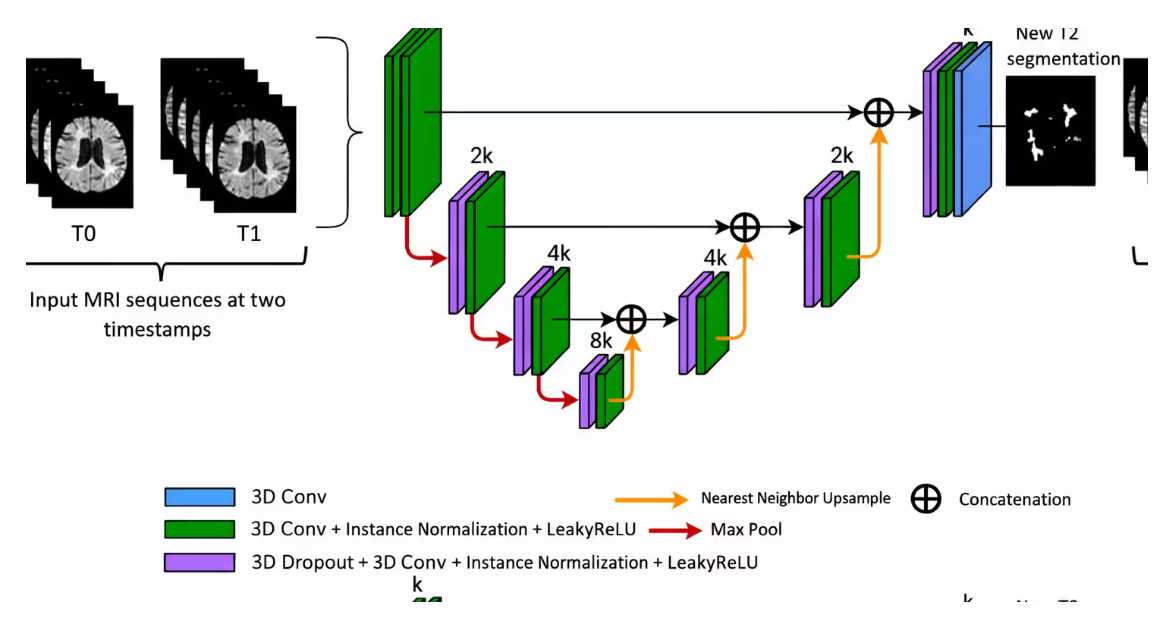
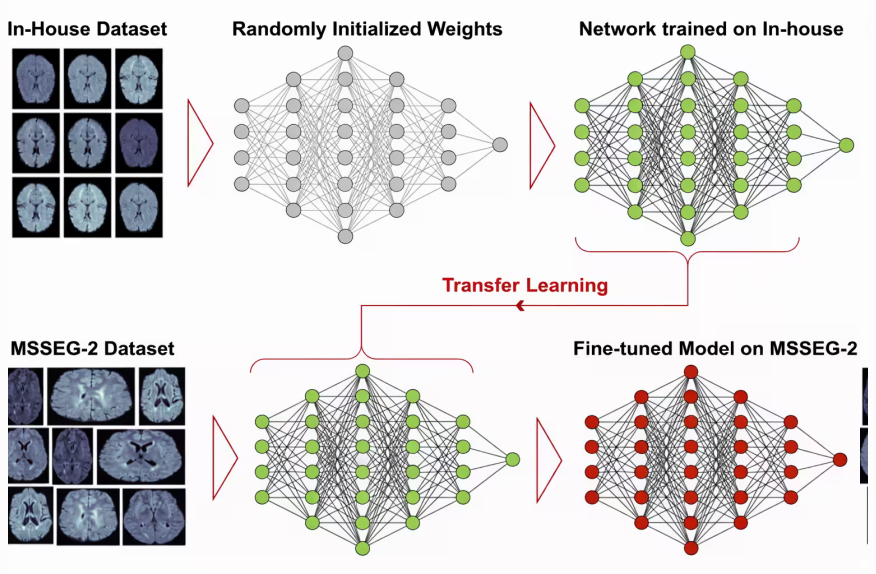
Neural Lab developed a specialized deep learning model based on the nnU-Net architecture, designed to detect new and enlarging MS lesions from FLAIR MRI scans taken at two different time points. To overcome the limited size of clinical datasets, we used transfer learning: pre-training the model on a large, diverse in-house dataset before fine-tuning it on the MSSEG-2 clinical dataset. This pre-training gave the model a strong foundation in lesion segmentation before it ever saw the target data, allowing it to capture the intricate patterns needed for precise detection with far less clinical training data than a model trained from scratch would require. We then conducted extensive hyperparameter tuning to optimize performance across the variability in imaging protocols and scanner hardware used by different clinics. The result was a model that automates lesion detection end to end: MRI scans go in, precise segmentation maps come out, with consistent accuracy and no manual intervention.
94% success rate and an F1-score jump from 0.516 to 0.662
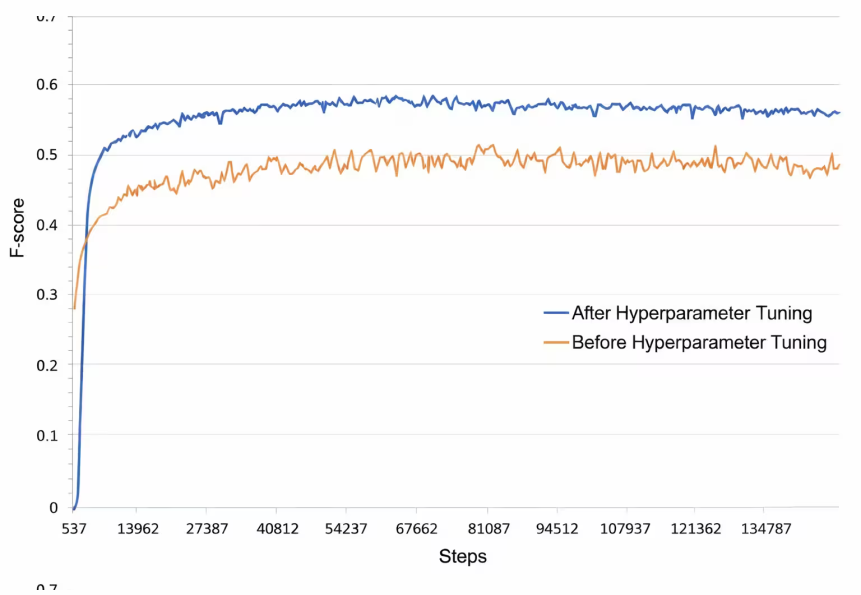
The fine-tuned model achieved a 94% success rate in detecting new and enlarging MS lesions, a substantial improvement over PVG's previous models. The F1-score, the standard metric for balancing precision and recall in segmentation tasks, improved from 0.516 to 0.662 after applying transfer learning and hyperparameter tuning. Beyond the metrics, the model eliminated the need for manual lesion segmentation, removing a process that was slow, subjective, and resource-intensive. Clinicians no longer need to compare MRI scans by hand to track disease progression, and the model's adaptability to different scanner hardware and imaging protocols means it can be deployed across clinical sites without per-site retraining.
Success
Reading

